It is quite common for boys to continue bed wetting for longer than girls. For example, most girls have broken this habit by the time they are 4 years old, it is more common for boys to be still bedwetting at this age.
My son continued bedwetting until he was over 7. It was as frustrating for him as it was for me,
It is easy to call into question your own parenting skills when a child suffers from bed wetting, although it’s important to remember that it’s rarely your fault. If your child has previously been dry then a visit to the Dr is advisable just to rule out any infections. Continue reading →
You read all the books and were totally prepared for the poo and the vomit and the crying and the soft spot in their head… but still you keep seeing things that make you wonder:
Is my child normal?
Probably. Put plainly, your child is more likely to be normal than not – and by ‘normal’ I mean displaying behaviours that are common and not cause for concern.
Here are ten weird, annoying, frustrating, confusing and totally normal things about your child.
1. She bites you on the shoulder when being carried and held.
This can be due to teething (have you noticed your baby gnawing on more than just your shoulder?), or it can be just an experimentation with cause and effect. This is a good sign as it shows your baby is learning more about the way the world works and testing what your response to a nip on the shoulder will be. To avoid getting chunks taken out of you, respond by putting her down without comment. Test completed! Soon with enough repetition she will probably decide the outcome isn’t worth the biting. Continue reading →
In recent years I’ve seen more and more babies wearing amber teething necklaces. You probably have too, both in the streets, in your circle of family and friends, and around the million dollar necks of celebrity offspring.
If you don’t know, these necklaces are made from Baltic Amber and are supposed to relieve pain and inflammation from teething. I’ve heard many people say they work, and many more who say they may as well try them even if they’re aren’t sure if they work, but here’s the rub: there’s not one single shred of evidence worldwide that amber necklaces have any affect on the body whatsoever – except to self-esteem, perhaps. I feel great when I wear some beautiful amber jewellery my dad gave me, but only because I look so lovely in it 😉
There’s two main arguments why I don’t think the teething necklaces should be used.
One of the top items on many new parents’ to-buy list is a nappy or diaper bag. It can shine like a beacon of hope against the fear that having a baby will mean you can never leave the house again. With a nappy or diaper bag you can hit the streets, hit the road, hit the town! Most people with whom I’ve worked nappy bags three or four times the size of their baby and filled to the brim.
Free image/jpeg, Resolution: 1500×1500, File size: 339Kb, diaper bag as a picture for clipart
I’ve already written about paring down your nappy bag so you don’t carry around more than you need. If you lessen the amount of stuff you bring with you on baby outings, then do you still need an expensive and large specialised nappy bag or just….you know… a bag?
#7 piece of baby gear you probably don’t really need: A specialised nappy or diaper bag
What makes a actual ‘nappy or diaper bag’ different from a regular bag?
Size: Most nappy or diaper bags are over-sized like a swollen tote or satchel. There’s a sense the nappy bag should be big enough to carry everything you might possibly need, but what actually seems to happen is that you carry everything it can possibly fit, regardless of whether you need it.
Aesthetics: The nappy or diaper bag often falls into one of two camps; super babyish or super stylish. Rather than chose whether to use a bag that announces your parenthood or one that defies it, why not use a regular bag that suits your style and budget that happens to have baby things in it?
Pockets: Nappy or diaper bags should have lots of pockets and sections to divide (and conquer!) all of baby’s bits and bobs. This is undoubtedly a boon, but there are many and varied regular bags that have just as many pockets and compartments.
Insulation: Some nappy or diaper bags have a layer of insulation, to keep milk and food warm or cool. This is a function that most people seem to use rarely and when you do, I think you’d be better off using a smaller – and more portable – insulated bottle bag or pouch.
Cost: A nappy or diaper bag will cost you more than a regular bag because it is called a ‘nappy or diaper bag’. Like many designer items, giving something a desirable label boosts its perceived value. A messenger bag or satchel, backpack, tote, or any other regular bag may do just as well as a nappy bag without costing as much.
Benefits of using a plain old regular bag instead of the nappy or diaper bag
For me, it comes down to cost, usefulness both in the short and long term, and personal taste. I think a nappy or diaper bag is likely to be overly expensive, less useful than it seems in the short term and in the long term potentially useless (will you keep using the baby patterned bag when your own baby is no longer in need of it? Will you use the posh bag that hides plastic lined pockets when you go out with friends?), and I find them cumbersomely large.
When I put the question of nappy or diaper bags or regular bags to some readers of a baby forum, several said they had used one initially but soon realised it was more of a burden than a help. Some suggested using adult bags like I’ve mentioned, and others embraced the baby style but at much less expense by buying children’s backpacks. For my money, I’d prefer to keep a nappy or diaper wallet – which is just what it sounds like, a large wallet that fits a few nappies or diapers and wipes – along with a few other small essentials in a casual bag I can use both with children and without. There are lots of choices out there and they almost always cost less than the specialised nappy or diaper bags!
I think it’s fair to say that all parents are aware of the need to babyproof their house, especially once their baby starts crawling, walking, and climbing. There are lots of obvious things parents jump to secure and lots of lists available to point out the main hazards and areas that need babyproofing.
But there are also lots of ways for your baby to get into trouble in your home that are often overlooking or the danger of which are underestimated.
Though falls and electrocution are usually the primary concerns for many families, and most readily addressed, a child between the age of 1 and 4 is actually most likely to be harmed from fire and burns, choking, drowning, or poisoning.
Of course you should place covers on the sharp edges of low tables, secure baby gates at the top of stairs, cover your electrical sockets, and limit the openings of windows to protect your baby from electrocution and falls, but don’t stop there!
Some dangers you may have overlooked:
House fire: Make sure you have working smoke detectors.
Oven and Stove: Consider putting a baby gate at the door to your kitchen, or if you can’t, a guard around the oven (which is often hot to touch) and stove-top (where saucepans can be pulled down).
Tablecloths: Don’t use them until your baby is older, or tuck all the sides up. Baby can pull hot drinks and heavy objects onto herself.
Hot drinks: Don’t underestimate how far you baby can reach or how high they can climb. Keep hot drinks off of low tables and well into the middle of higher tables. This goes for all small objects as well.
TV: These days many households have flat-screen TVs that are easy to pull over but still heavy enough to cause serious damage. Keep your TV pushed well back from the edge of its table.
Bookshelves: Anchor to the wall. They look great for climbing and can topple over and crush baby. Similarly, always keep drawers closed. An open set of drawers looks like a set of stairs to your baby.
Fridge Magnets: Don’t forget how far baby can reach. Keep all magnets well above the height you baby could reach on their very best day. Don’t forget to keep checking how high this is; baby is getting taller all the time!
Glass Doors: Well cleaned glass is invisible to your baby. Place stickers on the glass at their eye level – or dirty up the glass! 🙂
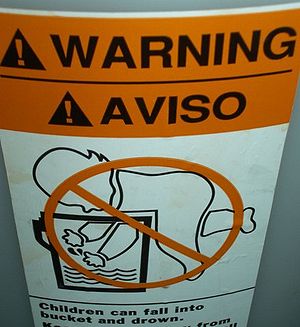
Toilet: Your baby can drown in the toilet. Because they are so top-heavy if she looks inside she can tip in headfirst and drown within seconds. Keep a latch on the toilet and keep the door shut. Similarly, be mindful of a bucket you may use when mopping the floor. Never let it out of your site and remove as soon as you’re finished.
Toys with beaded eyes: Many teddies have glass or plastic bead eyes that can be chewed off and become a choking hazard. Keep these toys for when your baby is older.
Dishwasher: Look inside yours and you might find knives. Keep it shut and latched at all times. Best if you can have that gate on the kitchen door.
Handbags: You may be used to putting any bags belonging to family members out of the way, but don’t forget those belonging to visitors. You have no idea what might be inside and many will have lotions you don’t want your baby swallowing and small items they could choke on. Designate a place up and out of the way where you can always ask guests to leave their possessions when visiting.
Rubbish bins: Most families realise they need to latch a cupboard containing medicines or poisonous cleaning products, but don’t forget these bottles end up in the bin. There may also be small items in here that your baby could choke on. Keep your bin latched or behind a latched door.
This is not a comprehensive list of every way you can babyproof your house, but a collection of tips that are sometimes left off more general lists or overlooked when babyproofing freestyle.
One of the best things you can do to make sure you’ve covered all the bases in your home is to get down on your hands and knees and crawl around the house. From this angle you can see what might look interesting to your baby, where potential hazards are, as well as get an insight into what they can’t see easily.
Also, don’t underestimate the power of teaching your baby to listen to your instructions. While a 1 year old can’t be given complicated instructions they can understand “No” and if you use the right tone of voice and expressions (low and stern) they quickly learn to understand when they are about to touch or open or do something they aren’t meant to. There are, frankly, more hazards than you could ever 100% babyproof for. While the major ones can be covered, there’s always going to be situations where a response to a well-timed “No” can save your baby from harm.
But here’s my #1 hot tip for keeping your baby safe: there are three words you must never forget



 NannySavvy