Not so long ago the playpen was a very common and ordinary part of a young child’s life. Ask your own parents or grandparents and there’s a good chance they not only used one, but did so without spending much time pondering over its evils or benefits. The playpen was as ubiquitous as the pram or the highchair.
But today it is far less common to see a playpen. Those who do use them often joke uncomfortably about “locking” their baby away, to buffer against the criticism of others. Forums are littered with parents questioning their pros and cons and asking for advice about whether a playpen will help or harm their baby and their family. Many feel the playpen has become a sort of anti-status symbol, where parents who use one believe they are looked down upon by those who do not.
Why the playpen has fallen from favour.
There are various websites and forum comments that allude to studies that show babies placed in playpens experience developmental delay and suffer long term mental and physical harm. But no one seems to be able to point to any such studies and Alison Gopnik, professor of psychology at University of California-Berkeley and author of The Philosophical Baby, says she ” [doesn’t] know of any systematic research on this.” What seems most likely is that advice about the importance of allowing a baby to move and explore their environment has been applied by concerned parents to playpens, though not intended to specifically warn against their use in their entirety. Continue reading →
In recent years I’ve seen more and more babies wearing amber teething necklaces. You probably have too, both in the streets, in your circle of family and friends, and around the million dollar necks of celebrity offspring.
If you don’t know, these necklaces are made from Baltic Amber and are supposed to relieve pain and inflammation from teething. I’ve heard many people say they work, and many more who say they may as well try them even if they’re aren’t sure if they work, but here’s the rub: there’s not one single shred of evidence worldwide that amber necklaces have any affect on the body whatsoever – except to self-esteem, perhaps. I feel great when I wear some beautiful amber jewellery my dad gave me, but only because I look so lovely in it 😉
There’s two main arguments why I don’t think the teething necklaces should be used.
One of the top items on many new parents’ to-buy list is a nappy or diaper bag. It can shine like a beacon of hope against the fear that having a baby will mean you can never leave the house again. With a nappy or diaper bag you can hit the streets, hit the road, hit the town! Most people with whom I’ve worked nappy bags three or four times the size of their baby and filled to the brim.
Free image/jpeg, Resolution: 1500×1500, File size: 339Kb, diaper bag as a picture for clipart
I’ve already written about paring down your nappy bag so you don’t carry around more than you need. If you lessen the amount of stuff you bring with you on baby outings, then do you still need an expensive and large specialised nappy bag or just….you know… a bag?
#7 piece of baby gear you probably don’t really need: A specialised nappy or diaper bag
What makes a actual ‘nappy or diaper bag’ different from a regular bag?
Size: Most nappy or diaper bags are over-sized like a swollen tote or satchel. There’s a sense the nappy bag should be big enough to carry everything you might possibly need, but what actually seems to happen is that you carry everything it can possibly fit, regardless of whether you need it.
Aesthetics: The nappy or diaper bag often falls into one of two camps; super babyish or super stylish. Rather than chose whether to use a bag that announces your parenthood or one that defies it, why not use a regular bag that suits your style and budget that happens to have baby things in it?
Pockets: Nappy or diaper bags should have lots of pockets and sections to divide (and conquer!) all of baby’s bits and bobs. This is undoubtedly a boon, but there are many and varied regular bags that have just as many pockets and compartments.
Insulation: Some nappy or diaper bags have a layer of insulation, to keep milk and food warm or cool. This is a function that most people seem to use rarely and when you do, I think you’d be better off using a smaller – and more portable – insulated bottle bag or pouch.
Cost: A nappy or diaper bag will cost you more than a regular bag because it is called a ‘nappy or diaper bag’. Like many designer items, giving something a desirable label boosts its perceived value. A messenger bag or satchel, backpack, tote, or any other regular bag may do just as well as a nappy bag without costing as much.
Benefits of using a plain old regular bag instead of the nappy or diaper bag
For me, it comes down to cost, usefulness both in the short and long term, and personal taste. I think a nappy or diaper bag is likely to be overly expensive, less useful than it seems in the short term and in the long term potentially useless (will you keep using the baby patterned bag when your own baby is no longer in need of it? Will you use the posh bag that hides plastic lined pockets when you go out with friends?), and I find them cumbersomely large.
When I put the question of nappy or diaper bags or regular bags to some readers of a baby forum, several said they had used one initially but soon realised it was more of a burden than a help. Some suggested using adult bags like I’ve mentioned, and others embraced the baby style but at much less expense by buying children’s backpacks. For my money, I’d prefer to keep a nappy or diaper wallet – which is just what it sounds like, a large wallet that fits a few nappies or diapers and wipes – along with a few other small essentials in a casual bag I can use both with children and without. There are lots of choices out there and they almost always cost less than the specialised nappy or diaper bags!
I think it’s fair to say that all parents are aware of the need to babyproof their house, especially once their baby starts crawling, walking, and climbing. There are lots of obvious things parents jump to secure and lots of lists available to point out the main hazards and areas that need babyproofing.
But there are also lots of ways for your baby to get into trouble in your home that are often overlooking or the danger of which are underestimated.
Though falls and electrocution are usually the primary concerns for many families, and most readily addressed, a child between the age of 1 and 4 is actually most likely to be harmed from fire and burns, choking, drowning, or poisoning.
Of course you should place covers on the sharp edges of low tables, secure baby gates at the top of stairs, cover your electrical sockets, and limit the openings of windows to protect your baby from electrocution and falls, but don’t stop there!
Some dangers you may have overlooked:
House fire: Make sure you have working smoke detectors.
Oven and Stove: Consider putting a baby gate at the door to your kitchen, or if you can’t, a guard around the oven (which is often hot to touch) and stove-top (where saucepans can be pulled down).
Tablecloths: Don’t use them until your baby is older, or tuck all the sides up. Baby can pull hot drinks and heavy objects onto herself.
Hot drinks: Don’t underestimate how far you baby can reach or how high they can climb. Keep hot drinks off of low tables and well into the middle of higher tables. This goes for all small objects as well.
TV: These days many households have flat-screen TVs that are easy to pull over but still heavy enough to cause serious damage. Keep your TV pushed well back from the edge of its table.
Bookshelves: Anchor to the wall. They look great for climbing and can topple over and crush baby. Similarly, always keep drawers closed. An open set of drawers looks like a set of stairs to your baby.
Fridge Magnets: Don’t forget how far baby can reach. Keep all magnets well above the height you baby could reach on their very best day. Don’t forget to keep checking how high this is; baby is getting taller all the time!
Glass Doors: Well cleaned glass is invisible to your baby. Place stickers on the glass at their eye level – or dirty up the glass! 🙂
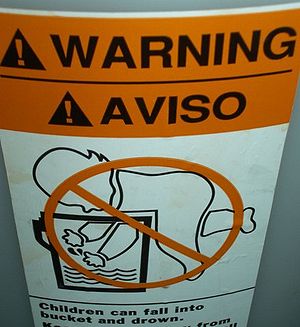
Toilet: Your baby can drown in the toilet. Because they are so top-heavy if she looks inside she can tip in headfirst and drown within seconds. Keep a latch on the toilet and keep the door shut. Similarly, be mindful of a bucket you may use when mopping the floor. Never let it out of your site and remove as soon as you’re finished.
Toys with beaded eyes: Many teddies have glass or plastic bead eyes that can be chewed off and become a choking hazard. Keep these toys for when your baby is older.
Dishwasher: Look inside yours and you might find knives. Keep it shut and latched at all times. Best if you can have that gate on the kitchen door.
Handbags: You may be used to putting any bags belonging to family members out of the way, but don’t forget those belonging to visitors. You have no idea what might be inside and many will have lotions you don’t want your baby swallowing and small items they could choke on. Designate a place up and out of the way where you can always ask guests to leave their possessions when visiting.
Rubbish bins: Most families realise they need to latch a cupboard containing medicines or poisonous cleaning products, but don’t forget these bottles end up in the bin. There may also be small items in here that your baby could choke on. Keep your bin latched or behind a latched door.
This is not a comprehensive list of every way you can babyproof your house, but a collection of tips that are sometimes left off more general lists or overlooked when babyproofing freestyle.
One of the best things you can do to make sure you’ve covered all the bases in your home is to get down on your hands and knees and crawl around the house. From this angle you can see what might look interesting to your baby, where potential hazards are, as well as get an insight into what they can’t see easily.
Also, don’t underestimate the power of teaching your baby to listen to your instructions. While a 1 year old can’t be given complicated instructions they can understand “No” and if you use the right tone of voice and expressions (low and stern) they quickly learn to understand when they are about to touch or open or do something they aren’t meant to. There are, frankly, more hazards than you could ever 100% babyproof for. While the major ones can be covered, there’s always going to be situations where a response to a well-timed “No” can save your baby from harm.
But here’s my #1 hot tip for keeping your baby safe: there are three words you must never forget
I am a big advocate of swaddling. In my experience young babies who are swaddled sleep much better than those who are not. Wrapping your baby is one the very first things I’d suggest if your baby has trouble falling asleep and staying asleep.
However, I do not recommend you buy a swaddle suit. Not only are they an unnecessary expense but can actually do more harm than good, potentially causing damage to your baby’s hips. All you need to swaddle your baby are muslin cloths.
#6 Item you should avoid buying your baby: Swaddle Suits
Why Swaddle?
Swaddling basically means “wrapping your baby firmly.” The sensation of pressure on their bodies mimics the feeling of being in the womb and provides comfort (like a hug!). This comforting feeling allows them to feel safer and more relaxed when falling asleep.
During the first months of life the Moro Reflex, or Startle Reflex, causes a baby to suddenly fling their arms out from their body. Not only does this physically startle a baby awake, but can be very surprising and upsetting to some babies. At this young age they don’t really understand that these arms are their own, so the feel and sight of them being flung out from their body is quite a shock. This reflex will often wake a baby and disturb what should be restful sleep. Swaddling keeps the arms wrapped firmly against the body and prevents the Moro Reflex from startling your baby awake.
Why shouldn’t I get a Swaddle Suit?
There are many brands and styles of swaddle suits available. I don’t profess to have used and assessed every one, so my recommendation not to use them is equal parts’ anti swaddle suit’ and ‘pro muslin cloth’ for swaddling. Some are wraps with velcro and buttons, others are zip up suits, there are many materials and styles and quirky names. What they all have in common is a price point well above a pack of muslin cloths and a full body constraint*.
Anti Swaddle Suit
Too often swaddle suits are not tight enough across the chest and upper body and too tight across the hips and legs. Many suits have little wings for the arms to sit above the head, directly contravening what I see as integral to the swaddle technique – having the arms tucked up against the body. The zip-up styles in particular are little more than tight sleeping bags and do not, in my opinion, provide enough pressure on the body to provide the comfort traditional swaddling affords.
Conversely, these swaddle suits will usually encase the lower body, pinning the legs into a straightened position. Babies are born with very loose hips, to assist delivery. Over the first few months of life the hips need to flex and move outwards to strengthen the joints. Babies who are wrapped too tightly across the hips when very young can get hip dysplasia, where the hips become dislocated and require weeks of treatment to correct.
* There are some swaddle ‘wings’ available that wrap only the arms. While these do not place unwanted pressure on the hips, I still feel they do not provide enough pressure on the upper body to warrant buying them instead of the muslin cloths.
A large square muslin cloth used for swaddling can (read: should) be wrapped firmly around the upper body with the arms against the chest, leaving the hips and legs only loosely wrapped and reasonably free. I have never noticed that babies are more or less comforted by wrapping that includes the legs; it is the pressure on their stomach, side, and back that provide the secure sensation.
Not only does the muslin cloth the provide a firm secure wrapping on your baby’s upper body without putting pressure on his hips, but they are significantly cheaper than the designed suits. You can usually buy a pack of four or five for less than one suit.
Once your baby no longer sleeps wrapped these cloths can be transformed for many other uses (everyday cloths for spills, light covering when very hot, to drape over pram to darken for naps, blankets for dolls, …. etc etc) whereas the swaddle suit will eventually be another expensive item you no longer have use for.
So, even though your baby would look super cute in a swaddle suit with tiny wings above his head,
I think you’ll find he sleeps better and grows stronger if you use a simple muslin cloth instead.




 NannySavvy